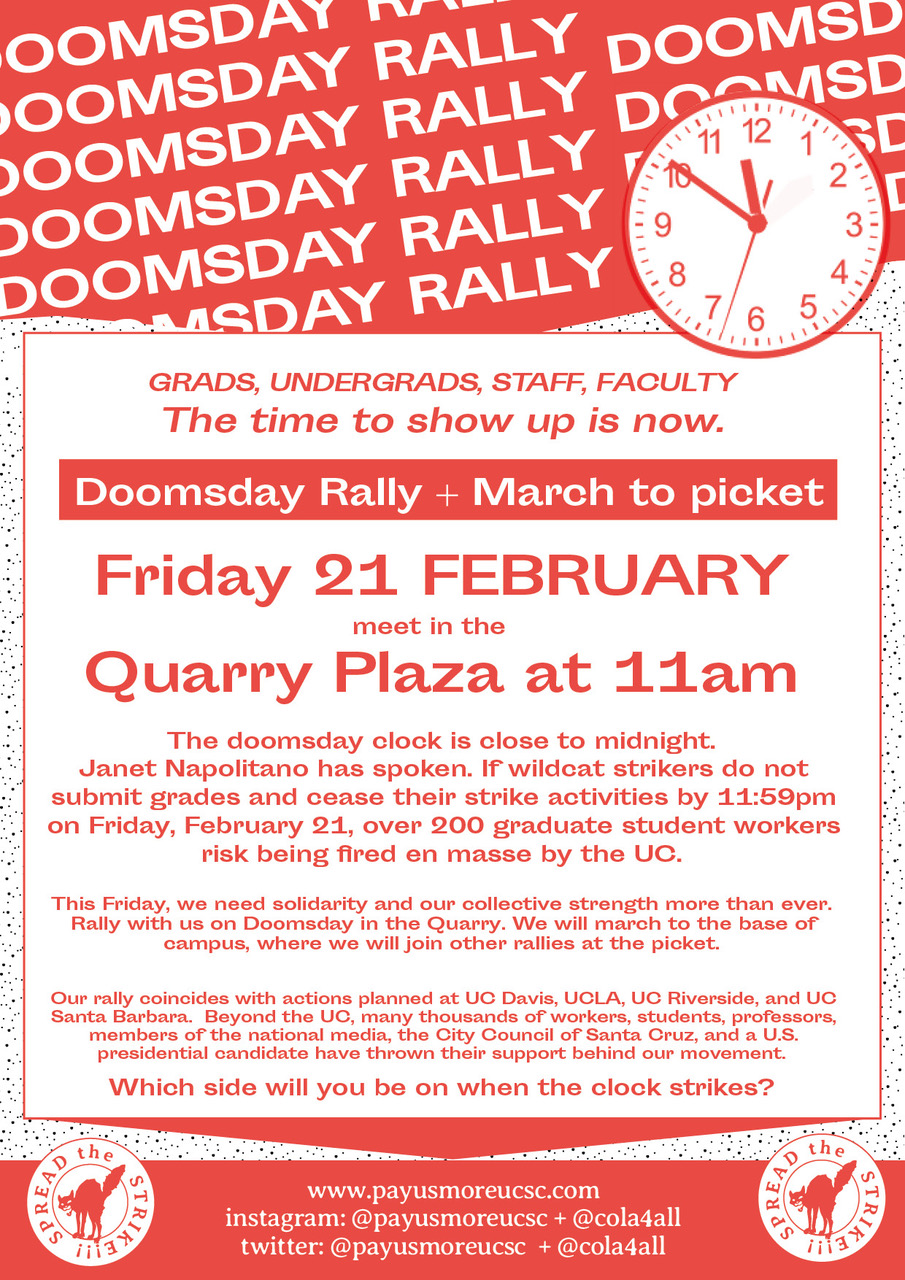
March for COLA, 11am Quarry Plaza

February 20, 2020

Dear grads,

Tomorrow will be big. Undergrads, faculty, lecturers, STEM, and townies are all marching for COLA and joining us at the base of campus for a rally. 

Contact your sections and invite undergrads to the march starting at 11am in Quarry plaza tomorrow, Feb 21. Let your students know that TAs engaged in the strike for a living wage might get fired and need undergrad support. We’ve seen incredible solidarity from undergrads since we first went on strike and this movement would not be possible without them! 

Reach out to your departments, text your friends, and turn out yourself! Picket starts at 7:30 and after everyone marches for COLA to the base of campus, we’ll have a big rally at 1PM.

We encourage everyone to wear costumes–let’s have fun before having to make a serious collective decision at the General Assembly (Friday, 4:30PM, Oaks 105).

Solidarity forever which is way past Doomsday!
Striking Graduate Students


STEM will meet at 10:45 am in the E2 courtyard and walk together to the quarry plaza to join the undergrads.

Everyone is welcomed!

United we fight. STEM won’t break the strike!


A Brief History of Wildcat Strikes

by Dana Frank, Professor of History Emerita, UCSC

In responding to the UCSC graduate students’ strike, the UC Administration has aggressively stressed that this walkout is “unsanctioned” by the UAW leadership and therefore, as a “wildcat” strike, is illegitimate and the University of California has no obligation to bargain.

However, many of the most powerful, successful, and popular strikes in US history have been wildcats. The concept of a “wildcat” strike is in fact a modern one, that grew out of a particular historical context that no longer exists. Before the 1930s, large groups of workers, with or without union approval (or sometimes even unions), commonly just withdrew their labor and made demands of employers, who could then choose to accede to those demands or not. The outcome was not necessarily enshrined in a contract. Only with the rise of the New Deal industrial relations system did the legal structure of the National Labor Relations Act codify a bureaucratic system of federally-managed elections, “collective bargaining,” and seemingly binding contracts–in which some unions chose to forgo the right to strike during that contract, in exchange for other gains.

During the years of powerful national unions, from the late 1930s through the 1970s, that system benefited many workers, in a context of countervailing powers and a federal government that generally accepted unions. But when both employers and the government broke out of that model beginning in the 1970s and turned aggressively against labor, contracts worsened dramatically. Gains for workers plummeted and contracts covered fewer and fewer workers within a given firm. Employers, always negotiating on a playing field far from equal, continue to force unions under duress to give up their right to strike. They exalt the sanctity of union contracts while themselves routinely violating agreements, laying off workers by the thousands simply because they chose to, or closing up shop altogether.

A “wildcat” strike means the strike is not “sanctioned,” that is, officially endorsed by a national union with which a local group of workers is affiliated. But some–but by no means all–of the national-level unions that control contracts in the US today are famously undemocratic. These routinely thwart democratic decision-making by rank-and-file members; they in some cases can negotiate contracts without consulting members; they repress union militancy rather than unleash it, in order to defend their own bureaucratic entrenchment. The more progressive national unions, by contrast, understand that rank-and-file militancy is the key to power. The United Auto Workers, with which the graduate students are affiliated, has long been one of the most famously undemocratic unions in the country. Its current leadership is facing criminal charges for corruption.

In the face of undemocratic, compromised leadership, workers in the US have routinely chosen to engage in “wildcat” strikes without national-level approval. Many of the most famous and crucial strikes in the modern US history have been wildcats, including the 1968 Memphis Sanitation Workers’ Strike, the 1970 national postal workers’ strike, and the recent 2018 West Virginia teachers’ strike. Unsanctioned strikes can mean workers forgo certain vital resources of solidarity, such as the support of Central Labor Councils and of unions whose own contracts give them the right to refuse to cross the picket line of another union only if that strike is sanctioned by the local’s national leadership. But wildcats also open the door to other forms of solidarity and creative militancy, and in many cases the previous hostile national leadership is forced to support the strike and, along with it, more militant demands.

The UC administration, then, can choose to assert the sanctity of a contract and stress that the UAW leadership has not approved this strike. But US labor history makes clear that contracts, and national-level systems of bureaucratic control, have always been simply tactics utilized by management or labor or both, as they chose or did not choose. Working people have a long, successful, and celebrated history of improving their lives–and those of others–using a far broader toolkit and a far broader vision of what democracy, and justice, look like.

International Students Statement

We are international graduate students at UC Santa Cruz on strike for a cost of living adjustment.


A February 7 email from UCSC’s International Student and Scholar Services stated that “ actions that result in student discipline or arrest may have immigration consequences, both on our current status and on possible future immigration applications you may make in the United States.” On February 14, EVC Lori Kletzer and UC President Janet Napolitano made this implicit threat of deportation a reality by threatening to revoke Spring 2020 work appointments for striking graduate students.

We can only assume that the UC administration understands that this is a de facto threat to deport dozens of international graduate students at UCSC. With the termination of our spring employment, we lose tuition remissions, without which we cannot remain enrolled full-time and without which our visas become forfeit. We have no protections and no guarantees, especially those of us from the global South, for whom student visa reapplications can be an uncertain and nightmarish process.

We see these threats as consistent with Janet Napolitano’s history as chief of the Department of Homeland Security, and we do not take them lightly. The UC has imperiled our futures in this country for participating in labor actions for living wages. We have no reason to believe that submitting grades and ending our strike activities will keep any of us safe from retaliation.

Many of us applied to study at UCSC for its tradition of scholar-activism, its social justice mission, and its stated commitment to diversity. Some of us took on financial and emotional risks by deciding to come to the U.S. for work and study in a Trumpian political climate of travel bans and anti-immigrant sentiment. All of us understand that our labor as teaching assistants is an indispensable component of the research and educational vision of this university.

The restrictions we face as visa holders drove us to go on strike in the first place. Under conditions of severe rent burden, many of our fellow graduate workers are forced into additional academic employment or low-wage side jobs. These options are unavailable to international students. We cannot take more than a 50% employment load on campus and are prohibited from seeking off-campus employment. We find it extraordinarily difficult to develop credit histories to support our tenant applications to local landlords.

We are on strike because our situation in Santa Cruz is untenable. For us, the most recent threat is only the formalization of our existing reality. Having recruited us to an unlivable situation, the UC is now making our status in this country impossible.

This statement was released by international students on February 19th, 2020.

Friday Undergrads4COLA March

February 19, 2020

The doomsday clock is close to midnight. Janet Napolitano has spoken. If wildcat strikers do not submit grades and cease their strike activities by 11:59pm on Friday, February 21, over 200 graduate student workers risk being fired en masse by the UC. 

The time to show up is now. The Undergrads for COLA Doomsday Rally and March is this Friday in the Quarry Plaza at 11am. 

If carried out, the consequences of this mass firing will be severe. For many strikers, it would spell the end of academic careers at UCSC. For the many international grad students on strike, this means de facto deportation from the United States. The sudden absence of hundreds of TAs from campus will drastically limit the ability of academic departments to offer classes, impairing the ability of many to graduate. Undergraduate education, especially in the Humanities, the Social Sciences, and the Arts, is likely to take a historically unprecedented hit. Contrary to the administration’s claims that they have your safety and well-being in mind, they propose sacking hundreds of graduate students—those who most closely mentor and supervise undergraduate academic work conducted at UCSC.

This Friday, we need your solidarity and your collective strength more than ever. Rally with us on Doomsday in the Quarry. March with us to the base of campus, where we will be joined by contingents from other rallies on campus—Faculty for COLA, STEM for COLA, Lecturers for COLA, and the many autonomous groups of students and workers springing up daily.  

Solidarity will ripple across the UC system as the strike spreads. Our rally coincides with rallies and pickets planned at UC Davis, UCLA, UC Riverside, and UC Santa Barbara. 

Beyond the UC, many thousands of workers, students, professors, members of the national media, the City Council of Santa Cruz, and a U.S. presidential candidate have thrown their support behind our movement. Which side will you be on when the clock strikes?

Undergrads for COLA! Solidarity forever!

Strike Updates Day 6

Strike Updates, Tuesday, Feb 18, 2020

For the sixth day, hundreds of graduate students, undergraduates, faculty, staff, lecturers, and others rallied at both entrances to campus. For the sixth day, all metro bus service to campus was disrupted by the picket line. In the afternoon, a huge group of STEM graduate students wearing lab coats once again marched to join the picket line, and joined strikers in peacefully shutting down the main entrance to campus, for the sixth consecutive working day. As of today, UCSC has spent approximately $1.8 million on the police presence at the picket line. By the end of this week, the figure will be approximately $2.7 million. Administration has so far offered nothing substantive–not even non-retaliation for those who they are asking to capitulate–and so tomorrow the strike continues!

In response to the cartoonish threats of administration and UCOP to fire hundreds of graduate students for participating in the strike, COLA strikes and actions are planned at every UC campus for this week. Tomorrow UCLA graduates are staging a sickout strike, and UCSB is considering going on a full strike to demand their own COLA. Meanwhile, UCSC undergraduate student government announced that they are introducing resolutions to investigate the offices of UCOP and UCSC administration, and to explore recalling EVC Kletzer for endangering students and negligence in the handling of this crisis. 

Tomorrow the UCSC faculty senate will meet to vote on two resolutions, one condemning the threats of the university to fire its graduate students and the infringement on faculty rights and academic freedom, and a second calling for higher wages and departmental autonomy in hiring and advocating for a meaningful resolution to the strike. 

To be very clear: The university’s current position is that they would rather destroy entire departments, including almost all of the social sciences and humanities at UCSC, and fire hundreds of graduate students than to have a single substantive meeting to discuss a solution to the cost of living crisis. This would willfully lead to graduate student homelessness, lack of access to medical care, and deportation for graduate students who already barely get by. That position is hopelessly reckless and must be abandoned. 
Alternatively, strikers once again invite the administration to the table to have a substantive conversation about the material conditions in which we live and to bring the strike to a peaceful end. 

Of note: More than a few strikers are ready to begin pushing for a university in which administrators are made irrelevant, and in which workers–faculty, students, and staff–govern the university collectively. One supporter asked: How much longer until we abolish the UC Regents and truly return this university to its core missions of teaching and research by placing it in the hands of its teachers, students, and scholars. 
Some of today’s action items: 

  • Join strikers on the picket line, beginning tomorrow at 7:30am. Please bring friends! You can also bring supplies: sunscreen, hand sanitizer, healthy food, and large containers of drinking water are always in demand. 
  • FACULTY: Please attend tomorrow’s faculty senate meeting and vote in favor of the resolutions condemning administration’s threats and in support of the COLA campaign. 
  • Cancel your classes and sections, and do not ask your students to cross the picket line. 
  • Lecturers should consider holding their classes at the picket. 
  • Push back the dates of large assignments, or as some instructors have done, cancel them. 
  • Write to the administration about how you feel about Lori Kletzer and Cynthia Larive threatening to fire hundreds of graduate students for demanding to be able to afford to live where they work. 
  • If you were a faculty member or student who witnessed or recorded video or photographs of police violence please write a description of what you saw and send footage to: mas1218@gmail.com
  • Share media coverage of the strike. 

As always, thank you so so much for your support, and extra special thanks to our undergraduates and to the faculty who have been coming out to support strikers–we are so grateful. See you tomorrow!

Notice of Violation of UC-UAW CBA

From: Sheila Kulkarni, Recording Secretary of the UAW 2865 Bargaining Unit at UCSB
To: Napolitano, Regents, Larive, Kletzer, Williams
CC: COLA UCSC and COLA UCSB lists
Date: Feb 18, 2020, 4:50 PM
Subject: Notice of Violation of UC-UAW CBA

Dear UC President Napolitano, and all others it may concern,

I hope this email finds you well. My name is Sheila Kulkarni, and I am the Recording Secretary of the UAW 2865 Bargaining Unit at UC Santa Barbara. 

First, I would like to thank you for your unwavering dedication to upholding our hard-won union contract. In your own words, “the obligations between the University and its unions are negotiated and memorialized systemwide in collective bargaining agreements.”

As such, I am obligated to inform you that your notice dated Friday, February 14th, 2020, indicating that strike participation “will have consequences, up to and including termination of existing employment at the University” is in violation of the UC-UAW Collectively Bargained Agreement (CBA), Article 3 (Appointment Security), Section D.

Article 3 Section D of the UC-UAW CBA states that an Academic Student Employee (ASE) appointment cannot be revoked when promised unless a student has become “academically ineligible.” Per a previous email from Veronica Hamilton, UAW 2865 Bargaining Unit Chair at UC Santa Cruz, the University is in receipt of at least 80 union grievances regarding fraudulent student conduct charges brought against striking TAs. As the University has already violated Article 8 (Discipline & Dismissal) subsections A and B by issuing these student conduct summons, the University has no standing to terminate ASEs who have been promised employment in spring quarter.

To be clear, if you are a TA who has been promised an appointment for spring quarter in any way, formally or informally, verbally or in writing, this statement from President Napolitano is in clear violation of your union rights. To remedy this, please get in contact with me or anyone on our contract enforcement team at santabarbara@uaw2865.org to file a union grievance. We are more than happy to help file grievances on behalf of our colleagues at UC Santa Cruz. 

It is shameful to see the UC administration so plainly transgressing the UC-UAW CBA that they have cited multiple times (falsely) as a way to avoid negotiating with UCSC graduate students. As such, I hope this issue can come to a speedy resolution in which the University revokes these baseless threats. I look forward to working with all parties involved. 

All the best,

Sheila Kulkarni
they/them/theirs
Rent Burden: 37% (what’s this?)
Ph.D Student, Department of Chemistry & Biochemistry
Unit Recording Secretary, UAW 2865
University of California, Santa Barbara

UCSC Call for Solidarity

February 18, 2020

Dear graduate students at other UCs,

Our struggle for a cost of living adjustment (COLA) is your struggle as well. In this crucial moment, we fundamentally and absolutely need your collective strength to help us. We have taken enormous risks, and our fight needs your solidarity now.

This Friday, February 21 at 11:59pm is the UCSC administration’s “final” deadline for the submission of “final” grades withheld in Fall quarter, set according to the public directive of UC President Janet Napolitano. To quote EVC Lori Kletzer: striking students have been given this deadline “to submit all missing grades, to end the strike and to fulfill their contractual obligations…Those who do not submit full grade information by February 21 will not receive spring quarter appointments or will be dismissed from their spring quarter appointments.”

Rather than sit down and bargain over our demand to be paid enough to live where we work, the bosses are willing to fire hundreds of ASEs. Wildcats at Santa Cruz therefore call on graduate students across the UC to hold a one-day picket this Friday.

For many of us at Santa Cruz, including dozens of international students, these disciplinary reprisals would not only endanger our position in the UC, and our careers, but our status in this country. We believe that the best defense against this obscene possibility is taking militant, offensive action, escalating our strike, and refusing to submit to intimidation.

The administration is terrified by the prospect of this strike activity spreading. In a meeting with admin over the weekend, we were told that the University of California Office of the President (UCOP) is unwilling to negotiate a COLA because there is no perceivable uptick in labor organizing at other UC campuses. We know this to be untrue, having a far better sense of the growing momentum than UCOP.

The time to demand a UC-wide COLA is now. Walk out on Friday in solidarity against the retaliatory measures that are being threatened against your UCSC comrades, but also to build collective power in the fight for the future of higher education. Organize in your departments, committing to defend one another and insulate each other from administrative retaliation. Perhaps most importantly, help us build a credible counterthreat to this administration by pledging, in your departments and divisions, to withhold grades in the event of retaliation against Santa Cruz graduate strikers.

We have all reached a crucial moment in this struggle, one that could decide its outcome. An injury to one is an injury to all. Show up for Santa Cruz grads under attack; show up for a UC-wide COLA. Let’s go!

Solidarity forever,
UC Santa Cruz Wildcat Strikers


Faculty Concerns About Recent Administrative Communications

****Please Forward Widely****

Dear Colleagues,

We write to share our concern over the two recent communications (“An Open Letter to Faculty, Staff and Students at UC Santa Cruz” from President Napolitano and “Graduate Student Strike Update” from iCP/EVC Kletzer, both dated February 14th) that threaten to dismiss Teaching Assistants who have not submitted Fall grades by February 21st from their Spring 2020 appointments. These two letters raise serious questions about the future of our campus. We cannot deliver high-quality undergraduate education without the face-to-face learning and evaluation provided by the talented and committed graduate student teachers who are themselves vital to UCSC’s nationally and internationally recognized doctoral programs and to our status as a research university.  The proposed EVC response to fall grades and the wildcat strike runs directly counter to our values and purpose.  

The administration’s proposed action will cause deep and lasting harm to both undergraduate and graduate education at UCSC (well beyond the disruption currently caused by the Teaching Assistants’ strike). In this time of increasing enrollment pressure at the undergraduate level and the necessity for large classes (as well as small research-oriented seminars), faculty cannot mount a quality curriculum that serves undergraduates without the indispensable pedagogical support of graduate student labor. Over the last few years, TAs in nearly every graduate program on campus have received enhanced field-specific training founded in research on effective and inclusive teaching. As a result, TAs have made immeasurable contributions toward  closing the equity gaps and ensuring success for an increasingly diverse undergraduate student body.

In addition to damaging undergraduate education, the proposed punitive actions will also severely erode, if not permanently damage, the doctoral mission of the University of California.  UCSC has been on a strong trajectory of doctoral growth and it boasts a diverse and robust set of programs. All of them stand to suffer as a result of the proposed actions.  Striking graduate students have already been negatively impacted by their rent burden and low wages; to dismiss them from their Spring 2020 positions only compounds the financial reasons that led to the wildcat strike in the first place. We fear that many graduate students will simply be unable to continue their education as a result. This year’s cohort of prospective graduate students may also be reluctant to accept offers, causing further damage to individual departments, undergraduate curricula, and UCSC’s strong and growing reputation as a major research university.  

As faculty, we are further concerned that the proposed measures constitute an infringement of the principle of shared governance, which grants Senate faculty the right to oversee curriculum and courses of study. Regents Standing Order 105.2 states: “The Academic Senate shall authorize and supervise all courses and curricula.”  The action threatened by the administration would have profound effects on our courses and curricula, constituting a change in the delivery of instruction. As such, it is not a step that should be taken without thoughtful and extensive Senate consultation and consent.

Graduate students, with the support of undergraduates, lecturers, staff, and faculty, have drawn attention to a long-standing problem. The current crisis offers us an extraordinary opportunity to come together as a community to reimagine the future of UCSC and, through honest and frank dialogue, construct the paths that will return UCSC to its place as an institution dedicated to knowledge in the service of social transformation.

It is our belief that even faculty who do not support the strikers and their tactics ought to be deeply concerned about the implications of these letters for the quality of education on this campus. We hope you will join us in insisting on faculty consultation and shared governance in this matter. We also invite you to affirm the critical importance of graduate Teaching Assistants to the educational mission of the University of California and to urge systemwide and local campus accountability, compassion, and creative problem-solving.

We hope you will attend the Academic Senate Meeting on Wednesday, February 19, to raise some of these concerns with campus leadership.

Sincerely,

The Faculty Organizing Group (FOG)

As I Complete My UCSC Doctorate

Dear Lori Kletzer, Cynthia Larive, and Quentin Williams:

I am an eighth-year PhD candidate in the Department of History and I write to you just weeks away from filing my dissertation and completing my degree. As someone who researches the history of the Black Panther Party, the labor mobilizations over the past two months have given me even more of an opportunity to critically reflect on our university’s fifty-five year history and its relationship to the Bay Area’s legacy of social and political activism.

I’m sure you all are aware that given our school’s geographic proximity to Oakland and its establishment just months prior to the emergence of the Black Power Movement, UC Santa Cruz is an important part of this rich local and national history. The connections between our school and the movement’s calls for racial and class equity go beyond these spatial and temporal parallels, however. In fact, one of the co-founders of the BPP, Huey Newton, received his PhD from our world-renowned History of Consciousness program. Not long after Newton completed his degree, Dr. Angela Davis—not a Panther herself but an active and visible ally of the Party—joined our school’s faculty contingent, marking the beginning of her 17-year career in the History of Consciousness and Feminist Studies programs. While Dr. Davis no longer teaches full-time, as a distinguished professor emerita she maintains an active presence in our campus community, producing scholarship and building coalitions around the issues of wealth disparity, racial violence, and mass incarceration in the United States- the same issues that she and Newton fought against fifty years ago. 

In 2016 our very own McHenry Library hosted a photograph exhibition in honor of the fiftieth anniversary of the founding of the Black Panther Party. For the exhibit’s opening and closing receptions former Black Panthers spoke to our undergraduate and graduate students as well as UCSC faculty and staff about their community organizing work during the Black Power Movement. They further encouraged our students to stay engaged in community issues, emphasizing the urgent need for young people’s participation in grassroots measures geared toward mitigating food and housing insecurity in Santa Cruz. Your administrative colleagues in the Division of Graduate Studies provided necessary and much appreciated funding for both events.  

As I conclude my second year on the academic job market, one of the most common pieces of advice I’ve come across from tenure-track faculty is the importance and necessity of gearing your application to the values, interests, and expressed needs of the campus to which you’re applying. This, I have heard, holds especially true for your interview with campus administrators, if you make it that far along in the application process. When UCSC’s faculty, students, and staff asked you why you wanted to work at UCSC, how did you respond? What answers did you offer our campus community, especially considering that over the past few decades UCSC administrators have been deeply complicit in perpetuating the housing and food insecurity experienced by an exponentially increasing proportion of our student body? 

I ask you this with genuine curiosity because as I sit at my desk reviewing the images in my dissertation from the BPP’s newspaper, I see chronicles of 1970s Oakland. I see the Party’s documentation of the city’s lack of affordable housing and the effects of profiteering and negligent landlords on local families. I see a visual record of the Panthers’ self-organized response to the federal government’s broken social welfare system and the dereliction of local officials. Juxtaposed with these photos are others documenting the weekly casualties of black men, women, and youth involved in the Panthers’ community programs, all at the hands of a highly militarized local police force. During my work breaks I turn to local and national coverage of our current labor movement only to see photographs of swarms of police, many of whom were recruited by you from the same Bay Area police departments that worked hand in hand with J. Edgar Hoover’s FBI to violently repress the Panthers and their free food programs. On multiple days of the graduate student strike these police arrived in full riot gear and confronted our undergraduate and graduate students, and our faculty with hostility and brutal violence. I’ve seen the videos of officers using excessive force to the point of crushing the bones and ripping open the skin of non-violent protestors, all against the backdrop of Martin Luther King Jr.’s image advertising our school’s annual convocation in his honor and in celebration of Black History Month. 

How can you hold pride in your work at UCSC when your behavior so blatantly contradicts your expressed concern for the well-being of the school’s employees and educators? Without our daily labor UCSC would not exist. Spending over $1 million to line our campus streets with armed police while telling us that you and your colleagues are working with an inadequate and rigid budget is a clear contradiction in discourse and practice. In addition to providing our chancellors with housing stipends the UC also provided at least one of them with an on-campus house, which currently remains unoccupied, all while more and more graduate students are forced to find shelter in their cars. While we take it upon ourselves to ensure that we have roofs over our heads and enough money in our bank accounts to eat, you meet our actions without one iota of concern for our humanity. When your colleagues graciously welcomed the former leaders of the Black Panther Party to speak with our students about the necessity and stakes of their community work in the 1970s, did any of these administrators mention UCSC’s pattern of hiring police squads to surveil and repress student and employee organizers? From what I recall they were conspicuously silent about this history. 

The rising tide of concerns expressed to you by student employees over the past two months is not a product of hyperbolic complaints. Rather, our testimonies point to the reality that our school is in the midst of a crisis. Your celebration of UCSC as an inclusive site of learning when the vast majority of our student population exists in massive debt and lives paycheck to paycheck is dishonest and self-serving. UCSC has become an educational institution for the wealthy. As UC administrators you have an obligation to take care of your students and employees and a responsibility to respect our central roles in maintaining our school as an institution of knowledge production. Over the past few decades UCSC’s institutional priorities have increasingly departed from the school’s early connection to the Bay Area’s civil rights movement and the progressive ideas and projects that came out of it.

My research explores questions of intergenerational relations in social movements, political legacy, and historical memory, and while I read through my chapters I’m reminded that history is chock-full of moments of contradiction, irony, and hypocrisy. Over the past two months you have demonstrated all three phenomena, and to me, that is at once depressing and infuriating.  

As I near the end of my graduate career, I prepare to leave our university unemployed, with few full-time academic job prospects, and thousands of dollars in debt. I checked my bank account this morning and at the moment I have a whopping 54 cents to my name. Do you have any creative ideas that would help me stretch this out enough to cover the cost of printing my chapters for their final round of committee feedback?

As historians we are encouraged to avoid hypotheticals, but it may be worth noting that if I had the chance to pursue a graduate degree at UCSC all over again, I probably would decide against it. Earning an education at this school is no longer financially tenable. 

I sincerely hope that the living and working conditions of future UCSC student workers are drastically better than what my fellow students and I have had to deal with, and what those who came before us experienced. Student poverty at UCSC has reached its breaking point and at this critical juncture it bears repeating that you have both the ability and opportunity to do the right thing.

Lastly, if nothing I’ve expressed in the above paragraphs resonates with you, I will end by reiterating what many have already conveyed to you: the country is watching you right now and waiting to see how you will respond to the needs that our campus community has vocalized to you, loudly and for too long. National media coverage of the current strike by outlets including the Los Angeles TimesThe New York Times, and The Washington Post, has been overwhelmingly sympathetic to the plight of UCSC students and our growing movement. How will you add to UCSC’s legacy? 

Sincerely,

Kiran Garcha

(PhD Candidate, Department of History, UCSC)

Response to Janet Napolitano: SPREAD THE STRIKE

Dear COLA community, 

TL;DR: 

By any assessment, we are winning this struggle. Graduate students will meet on Tuesday evening, after the sixth day of picketing, for a General Assembly to discuss our response to the latest threats from UCOP (details forthcoming). If you are a graduate student worker withholding grades from Fall 2019, do not submit before this meeting. More than ever, we need to move collectively. First step: organize within your department. See you at the picket on Tuesday, from 7:30am onwards. 

Yesterday evening, our General Assembly concluded with a unanimous decision by strikers and picketers: the strike continues on Tuesday. 

Later that same evening, we received our first communication from UC President Janet Napolitano, with threats to our current and future employment if fall grades are not submitted by next Friday, February 21.

This is a decisive moment in our struggle. As long as graduate students continue to move together, we will undermine these threats, revealing them as a last-ditch scare tactic, a desperate bluff. These threats are credible only if the UC leadership is prepared to sink UCSC and risk indelible consequences to the university at a statewide level. It does not take much to imagine how a mass firing of rent-burdened graduate students on this campus would ignite protest and boycott across the UC system. 

If hundreds of graduate student workers are terminated from employment, whole departments will be unable to offer courses next quarter, dozens of international graduate students will effectively face deportation, UCSC rankings will nosedive, huge sources of funding will be jeopardized, political organizing at other campuses will intensify, and UCSC may become subject to academic boycott (over 1,000 non-UCSC scholars and educators have already committed to a pledge of solidarity and non-cooperation with UCSC). In short, such a move would profoundly impoverish graduate and undergraduate education and research at UCSC, as well as its collaborations and partnerships with other research institutions.

So far, over 200 graduate students have received warning letters from the university for continuing to withhold at least 71% of their Fall 2019 grades beyond February 2nd. Since the start of our full teaching strike, our five-day picket at the base of campus has drawn several hundred graduate students, undergraduates, faculty, lecturers, and staff. The sheer size of the crowd repeatedly filled the university lawn and spilled into the Bay and High intersection, effectively shutting down the major entrance to campus every single day this week. The midweek police presence — excessive in their arms and in their brutality — was visibly scaled down after the masses at the intersection showed that they would not be arrested and beaten into submission. 

Let’s assess the concrete effects of these actions. Collective direct action forced the first round of concessions from the UCSC administration, even if these early concessions (as any student of labor history could have predicted) were grossly inadequate to our demands. Collective direct action has sent administrators scrambling as the university reels from the effects of 12,000 withheld grades: The mobile and arbitrary deadlines for grades—December 18th, February 2nd, and now February 21st—bears witness to the fact that the UCSC administration is unable to compensate for or offset our actions. Collective direct action has revealed the administration’s alleged inability to meet with strikers was in fact and remains a politically motivated refusal. Collective direct action has forced the university to show its hand by unveiling the biggest stick it has at its disposal: Janet Napolitano herself stepping forward from behind the curtain to threaten mass firings. Every move made by UC administrators up to this point has been one failed attempt after another to dilute and diminish the collective power we continue to build.

If we set ourselves the unpleasant task of thinking from the perspective of the UC President, we can conceive of two reasons why the highest level of administration has made a calculated, strategic decision to unveil its biggest threat. The hyperbole of the administration’s current threat of retaliation teaches us not only that ‘they mean business’ but also, and more crucially, that business is their highest priority. While they may be indifferent to our rent burdens, they cannot remain indifferent to the disruptive effects of our withheld labor (and especially of the withheld grades) on the university’s operations. If our mid-January strike poll was any indication, the number of graduate students in favor of withholding Winter 2020 grades (715) holds promise for a disruption on an even greater order of magnitude. Our readiness to escalate is profoundly unsettling for UC leadership. 

But perhaps for them what is even more disconcerting is the writing that’s now undeniably on the wall: the strike is spreading. Kletzer, Larive, Napolitano—the string-pullers behind the riot helmets, batons, and their indiscriminate use—may have been unwilling to administer beatings themselves, but at the drop of a hat they blew an estimated $1.5 million this week on cops from across the state, so that strikers found themselves facing off against police from UC Berkeley, UC Davis, UC San Francisco, UC Santa Barbara, and even UC Irvine, not to mention the notorious Alameda County Sheriff’s Office. While the UC system mobilizes its statewide penal resources in the hopes of overwhelming what they see as a local problem, we are strengthened by the proliferation of COLA movements organized by rank and file graduate student workers on at least five other UC campuses. UC Santa Barbara graduate workers will circulate their own strike poll in a matter of days. UC Davis organizers have come to our picket line day after day this week to express solidarity and share reports of the rapid growth of their own COLA campaign. Storms are brewing in mass meetings and rallies at UC San Diego, UCLA, and UC Berkeley. Campus and statewide administrators cannot afford to wait us out, because neither we nor any other COLA movement in the UC show signs of slowing down. The threat of mass firings represents a last, desperate hope that they can crush this movement once and for all. 

In short, the appearance of the university’s most forceful threat of retaliation reveals its position of weakness, while nonetheless pushing the COLA movement to a critical and decisive juncture. In this next week more than any other, graduate students need to organize and act collectively. 

This is a call to organize within your department and with comrades in departments across the academic divisions over the next seven days. 

This is a call to show up at the picket line from 7:30am on Tuesday morning, to make our collective presence felt at the base of campus. 

This is a call to a General Assembly on Tuesday evening, where graduate students will meet to discuss Napolitano’s threats of mass termination, and to decide how to proceed. Many of us are feeling the real weight of these threats, and will each assess considerations of our own as the February 21st grade submission deadline approaches. As we’ve done all along, and as today’s mass email threads have shown, our militant struggle is anchored by a fierce spirit of mutual aid. Our collectivity is our most precious resource and moving together will give us the best chance we have at keeping each other safe. Watch your inbox for more details on the General Assembly. 

Happy Valentine’s Day. Spread the strike. DO NOT SUBMIT.

Love,

Graduate Students Association 

UAW 2865 Santa Cruz

Graduate Students Wildcat Strikers